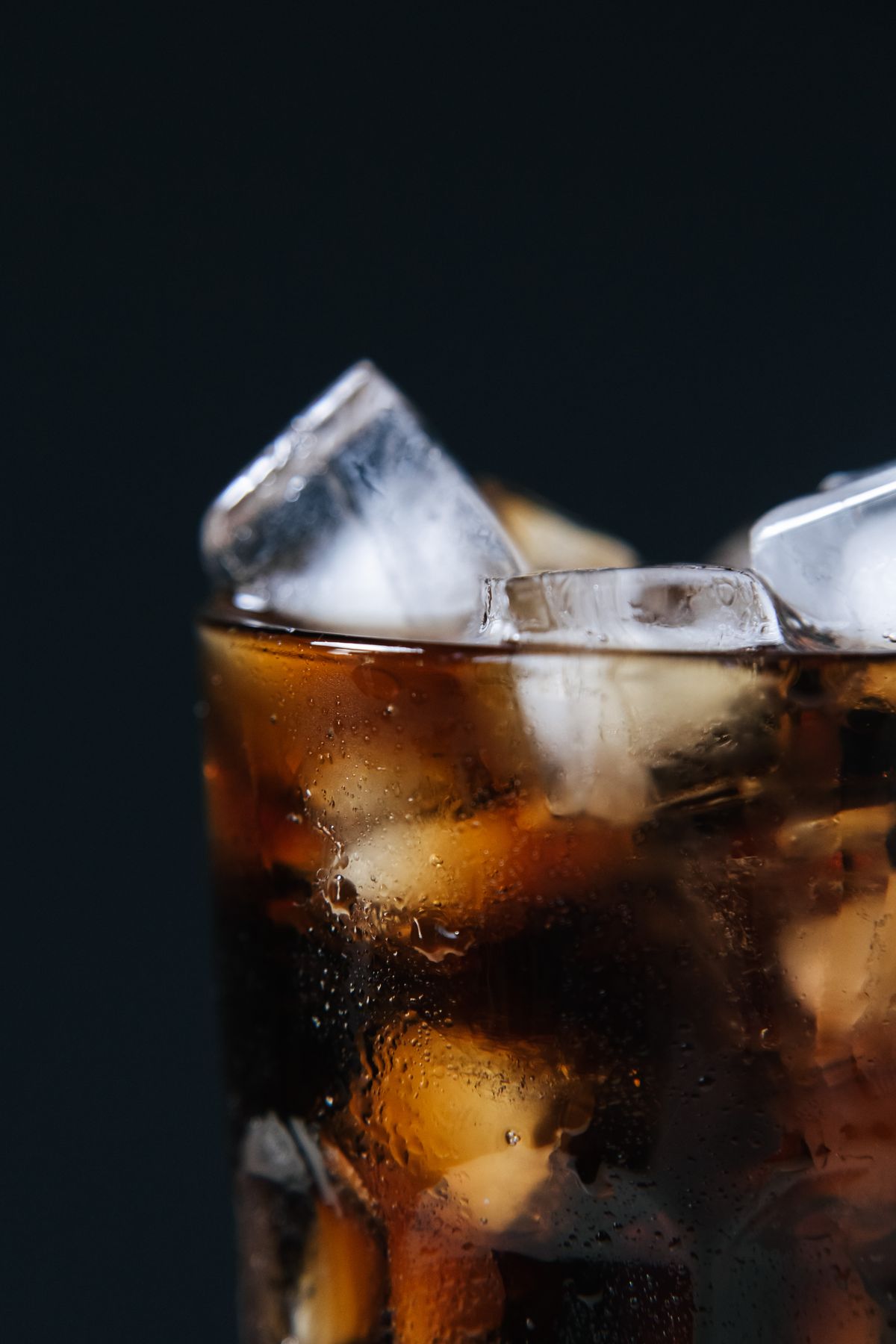
You fill a glass with ice, pour something cold over it, and the cubes make a noise somewhere between a pop and a snap. It happens fast and then stops. If you have ever stood in a kitchen at midnight and found that sound oddly satisfying, you are not alone. The question is why it happens at all — ice is cold, the drink is cold, so where does the stress come from?
Ice is not a single temperature
When ice comes out of a standard home freezer, the outside of each cube has been sitting at somewhere around minus eighteen degrees Celsius. The inside, though, never quite equalised — it is colder still at the core, especially in thicker cubes where heat exchange is slower.
Pour a liquid over that cube — even a cold one, say four degrees — and the surface of the ice is suddenly exposed to something significantly warmer than it was a moment before. The outer layer wants to expand slightly in response to the warming. The inner layer does not yet know anything has changed.
What thermal shock actually is
Thermal shock is not just rapid temperature change. It is rapid temperature change across a material that cannot move fast enough to accommodate it. In an ice crystal, the molecules are arranged in a lattice — a structured, repeating pattern held together by hydrogen bonds.
When the outside of the lattice expands and the inside stays contracted, the material is being pulled in two directions simultaneously. Ice is not flexible in any meaningful sense. So instead of bending, it fractures — along whatever internal weakness was already present in the structure of the crystal.
The crack sound is that fracture happening. Often you will hear several in rapid succession as the shock wave propagates through the cube and triggers splits at multiple weak points.
The cracking is not incidental. It is ice doing what rigid materials always do when the thermal maths outpace the mechanical tolerance.
Why some ice cracks more than others
Commercially made ice — the kind from a bag or an ice machine — tends to crack less dramatically than home freezer ice. The reason is that commercial ice is frozen slowly and at controlled temperatures, which gives the crystal structure time to form more uniformly and with fewer internal stress points.
Home freezer ice is frozen quickly and unevenly. It tends to be cloudier (the cloudiness is air and impurities pushed to the centre as freezing progresses from the outside in), and that centre is also weaker structurally. When thermal shock hits, there are more places for fractures to start.
Japanese cocktail bars that use large, extremely clear ice spheres made from very pure water frozen over many hours see almost no cracking — those ice structures have no internal inconsistencies for a fracture to follow. The trade-off is that each sphere costs more time and effort than its cooling contribution technically justifies.
The sound itself
The cracking sound is the release of energy that had nowhere else to go. When a fracture propagates through a solid, the two newly formed surfaces snap apart and vibrate briefly. In water ice that vibration travels through the liquid in your glass and reaches your ear as a sharp, resonant pop.
The reason it often sounds pleasant — rather than alarming, the way glass breaking sounds — probably has something to do with the pitch and the speed of decay. The sound is high, brief, and immediately damped by the surrounding liquid. Your nervous system does not have time to interpret it as a threat.